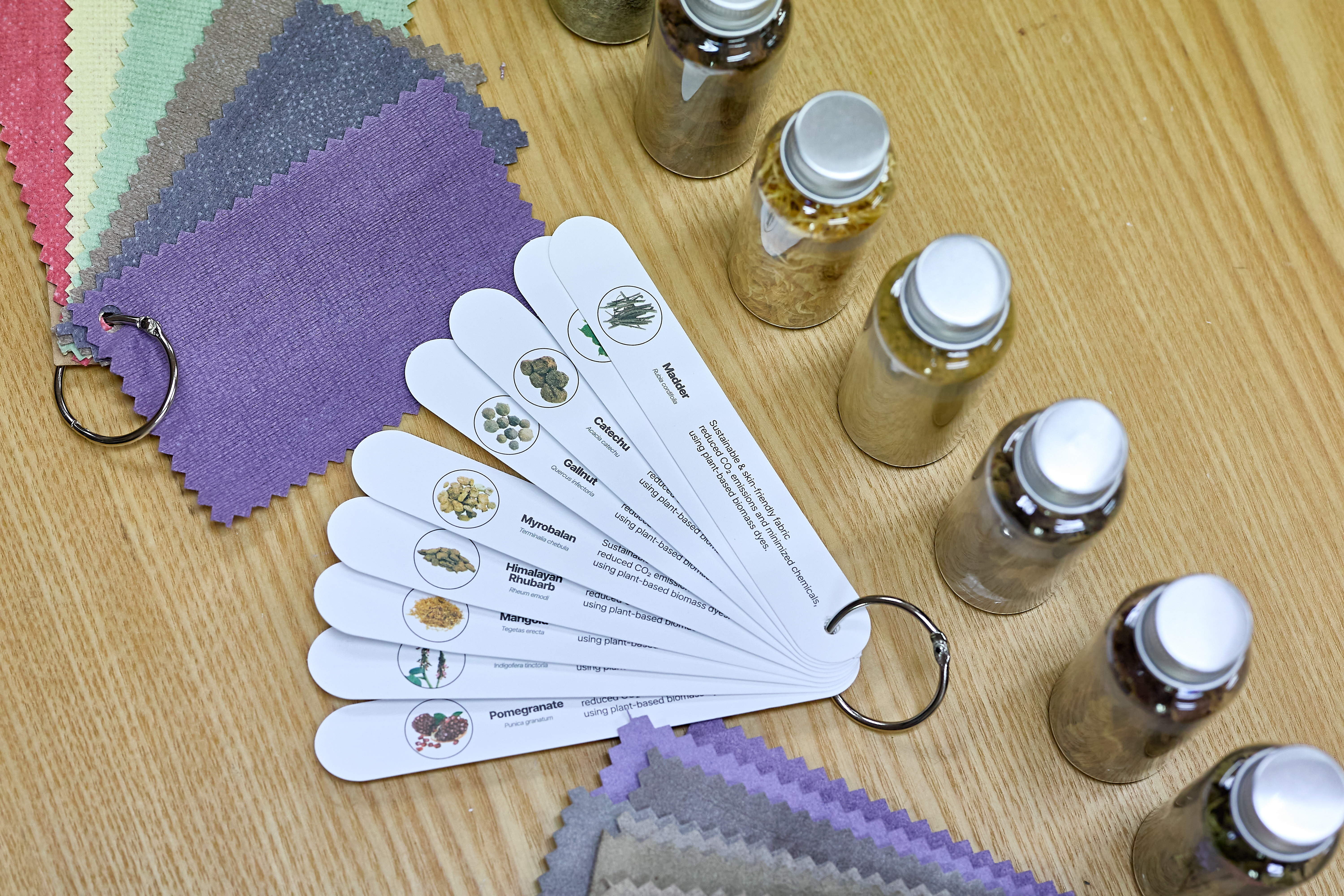
GREENWEAR dyed fabric swatches, dye materials and tags identifying their sources. Photo: GREENWEAR.
Verifying natural dyeing requires two connected forms of evidence: analysis of a dye’s biobased origin and compositional evidence linking that dye to the dyed fabric. GREENWEAR combines carbon-14 analysis with HPLC-DAD and LC-MS marker compound comparisons to establish this link. It provides its own natural dyeing verification tags and stickers for fabrics verified through the system.
Can existing textile certifications verify natural dyeing?
There is no widely adopted single global certification dedicated solely to confirming natural dyeing. Standards covering organic textiles, harmful substances and manufacturing inputs must be interpreted according to their respective purposes.
Framework | What it addresses |
|---|---|
GOTS and input approval | Organic textile processing and input requirements |
OEKO-TEX® STANDARD 100 | Harmful substance testing of certified textile articles |
ZDHC MRSL conformance | Restricted substances in manufacturing chemical inputs |
Natural origin analysis | Dye carbon origin and marker compounds in fabric |
GOTS approval of a dye or auxiliary does not establish that it is a natural dye. STANDARD 100 does not identify the natural origin of a colourant. ZDHC MRSL conformance concerns manufacturing inputs and does not certify every attribute of the finished article.[1][2][3]
Supplier documentation should reflect these distinctions. Checking a product certificate’s scope and validity, and examining analytical evidence for a natural dyeing claim, are separate parts of a sourcing review.
Why did GREENWEAR establish its own verification system?
GREENWEAR specialises in natural dyeing and does not perform conventional dyeing using synthetic dyes. The company has maintained a production policy under which no synthetic chemical dyes have been brought into its factory since its establishment.
Improvements in quality and productivity through Biomass Natural Dyeing prompted questions about whether synthetic dyes had been used. These questions reflected a gap between the technology’s performance and the assumption that poor colourfastness and production limitations were inherent to natural dyeing.
GREENWEAR developed an analytical system connecting raw material origin with fabric application. Reviewing it alongside the company’s Biomass Natural Dyeing technology allows sourcing teams to assess technical performance and material origin against their respective evidence.
What does carbon-14 analysis measure in a dye?
ASTM D6866 uses radiocarbon analysis to assess a sample’s biobased carbon content. It distinguishes carbon from recently living sources from fossil carbon, in which carbon-14 has decayed over geological time.[4][5]
GREENWEAR uses analysis by Beta Analytic in the United States to assess the biobased origin of its dyes. The result provides the origin evidence used in conjunction with subsequent marker compound comparisons between dye and fabric.
Interpret the result alongside the sample’s composition
Biobased carbon content is the proportion of a sample’s total organic carbon that comes from biobased sources. It is not a direct measure of dye dosage, a garment’s natural fibre blend or the mass fraction of natural ingredients in the entire product.[4]
For example, GREENWEAR’s published Madder data reports 52% biobased carbon and explains that an alpha hydroxy acid (AHA) is used during extraction. This does not translate directly into “48% synthetic dye.” Interpretation requires consideration of the tested sample and the carbon contributed by extraction or formulation ingredients.
Carbon-14 analysis alone also cannot establish every processing step or whether an individual molecule was synthesised. Connecting evidence of carbon origin with evidence of the compounds actually used is central to GREENWEAR’s verification approach.
How is the dye connected to the finished fabric?
GREENWEAR compares marker compounds in a dye whose biobased origin has been assessed with those in the dyed fabric. Marker compounds are representative substances selected for analysis and comparison.
The company uses HPLC-DAD and LC-MS analysis by the Korea High Tech Textile Research Institute (KOTERI) to examine dye and fabric composition. The results show whether compounds identified in the dye are also found in the dyed fabric.
The same compound can arise through different raw material routes. A marker match is therefore interpreted together with the carbon-14 result, rather than treated as independent proof of natural origin. Conversely, a dye’s carbon-14 result alone does not establish that the dye was used on a particular fabric.
The review follows three steps:
Dye origin: assess biobased carbon through carbon-14 analysis.
Dye-to-fabric connection: compare marker compound results.
Product application: confirm how the tested material relates to the fabric being sourced.
Published dye data is available on the natural origin analysis page. During sourcing, use the fabric reference and colour to identify the relevant analytical documentation.
What is the role of GREENWEAR’s verification tags?
GREENWEAR issues its own natural dyeing verification tags and stickers for fabrics verified through this system. They translate material origin and supporting analysis into information customers can understand.
The issuer is GREENWEAR. These are company-issued labels, distinct from independent GOTS or OEKO-TEX certification marks. Brands can coordinate the applicable fabric, available labels and product description wording to communicate the material’s characteristics consistently.
A technical review uses origin analysis, quality data such as colourfastness, and product-specific harmful substance testing for their respective purposes. Evidence of natural origin should not be extended into a single assurance of every safety or environmental attribute.
Contact GREENWEAR with your proposed material, colour and verification requirements to discuss fabric selection, analytical documentation and the use of its verification tags.
Sources
Production practices, the company’s experience of questions about its technical improvements, and the tag programme are based on information supplied by GREENWEAR. The analytical system and Madder example are drawn from its published natural origin analysis materials.