
What is GREENWEAR’s Biomass Natural Dyeing?
GREENWEAR’s Biomass Natural Dyeing applies modern science and technology to traditional natural dyeing, substantially improving its quality and productivity. We analyse and process colourants extracted from natural resources, then design dyeing processes for different fibres to produce fabrics for the fashion industry.
Biomass means resources of biological origin. Colourants found in materials such as pomegranate rind are the starting point for our dyestuffs. Extracting colour from a raw material and achieving consistent results on a fashion fabric, however, are two distinct technical challenges.
Natural raw materials contain a mixture of colourants and other constituents. Their composition varies, as does their behaviour during dyeing, so knowing the source material alone does not determine the final shade or result. GREENWEAR analyses these characteristics and uses the findings to guide dyestuff processing and dyeing design. Connecting natural resources with textiles
In practical terms, GREENWEAR develops dyestuffs and processes that make naturally derived colourants usable in fashion production. Explore the materials we use and their characteristics in our biomass dyestuff library.
How does the process move from raw materials to production?
Development and application follow a connected sequence: raw-material analysis → dyestuff processing → fibre-specific process design → trial dyeing → refinement based on the results. Each stage helps translate the characteristics of a natural resource into colour on a finished fabric.
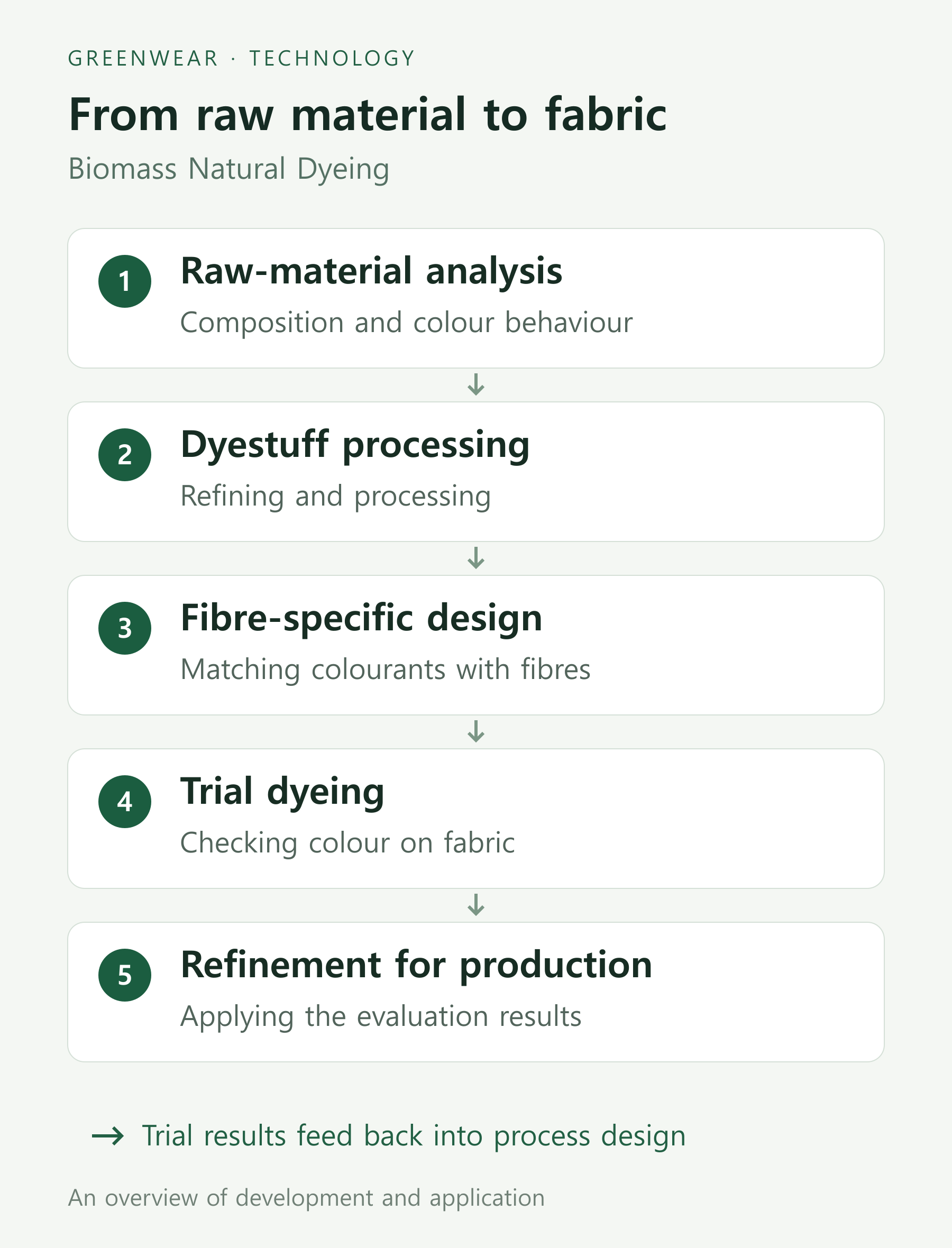
Process overview: trial results feed back into process design.
Raw-material analysis: understand what creates the colour.
We examine the dyestuff’s composition and colour-forming characteristics. This establishes both what the raw material is and how it behaves during dyeing.Dyestuff processing: prepare the dyeing material around those characteristics.
Colourants obtained from the raw material are refined and processed using the analytical findings. Their composition and colour-forming behaviour guide how the dyestuff is prepared. How biomass dyestuffs are developedFibre-specific process design: match the method to the colourant and fibre.
Even with the same dyestuff, a change of fibre requires the dyeing conditions to be reviewed. Fabric composition, blend ratio, construction and target shade all inform the process design.Trial dyeing: test the design on fabric.
We dye a trial fabric and compare the result with the target. This checks whether the colour anticipated during analysis and design can be achieved on the chosen material.Refinement and production application: use the findings to improve the next run.
We evaluate colour and quality, then adjust the process where needed. Checks cover evenness across the fabric, colour durability in use and consistency with the reference shade in repeat production. The findings feed into process control. Process design and production management
Trial results return to the design stage. Through analysis, testing and refinement, GREENWEAR develops methods suited to each material and colour and puts them into production. Connecting research with production
How does it differ from traditional natural dyeing?
The starting point is shared: colour obtained from nature. The technical advance in GREENWEAR’s Biomass Natural Dyeing is to connect raw-material composition, fibre-specific dyeing behaviour and repeat production within a single design and control system.
Understanding the raw material through its composition and colour behaviour
Saying that a fabric is “dyed with pomegranate” identifies the colour source. Yet even raw materials of the same kind can vary in composition from one batch to another. Using the same type and quantity of raw material does not automatically ensure the same dyeing result.
GREENWEAR analyses composition and colour-forming characteristics, then applies those findings to dyestuff processing and process design. Understanding and managing the colour-forming constituents from the raw-material stage is a key technical difference. Alongside checking the colour after dyeing, we plan earlier in the process how the selected materials will deliver the intended result. Raw-material analysis and process design
Designing around the characteristics of each fibre
Fashion fabrics extend well beyond cotton. Cotton, Tencel, modal, polyester and nylon have different properties, and fabrics often combine several fibres. Applying naturally derived colourants to these materials calls for a process designed around the dyestuff–fibre combination.
GREENWEAR has expanded its applications by evaluating colour and quality for each material. Biomass Natural Dyeing is used on cotton and regenerated fibres, as well as synthetic fibres and blends. This gives designers a broader choice of materials. Material applications
Turning a successful shade into repeatable production
Fashion production needs both a successful sample and the ability to maintain its reference shade across later production runs. The dyeing result and the conditions that produced it therefore need to be managed together.
GREENWEAR records raw-material and process histories, comparing reference and production samples to manage colour consistency. Findings from testing are applied to subsequent production to support repeat orders. Building a system that can reproduce an established colour is a key advance for industrial application. Quality control for repeat production
Explore fabrics made with Biomass Natural Dyeing in our fabric library to see how dyestuff and process development translate into materials.
What has improved in technical and environmental performance?
Biomass Natural Dyeing has delivered improvements in the quality and production performance of fashion fabrics, alongside a lower environmental burden from dyeing. These are distinct outcomes.
Technical performance: better quality, production capability and colour choice
Colour fastness: Colour durability against washing, light and rubbing has improved. This helps fabrics resist colour change, bleeding and transfer during wear and care.
Levelness: Shade variation across the width and length of a fabric has been reduced. The result is more even application of the intended colour within the same fabric.
Reproducibility: Raw materials and processes are managed to match a reference shade when a colour is produced again. This provides a basis for carrying the colour selected at sampling through to bulk production and repeat orders.
Productivity: Systematic raw-material processing and fibre-specific dyeing processes support production at industrial scale. A production system capable of handling repeat orders broadens the commercial applications of natural dyeing. Technology and production management
Colour variety: Work on biomass colourants and their application to different fibres has expanded the range of achievable shades. More colour options across materials give brands greater choice when planning products. Colour collections by material
Environmental impact: lower carbon emissions, wastewater pollution and chemical burden
Carbon emissions: Lower-temperature, shorter processes reduce heating energy requirements and the associated process burden. More efficient energy use lowers carbon emissions during production. Resource efficiency in the process
Wastewater: Improvements to raw materials, additives and processes have reduced the concentrations of organic matter and suspended solids in discharged wastewater. This reduces the water-pollution burden associated with dyeing. Wastewater analysis
Chemicals: We reduce the range and use of synthetic additives in the process while also managing residues in finished fabrics. Managing both process inputs and product residues helps lower the chemical burden. Input and residue management