
The texture of blue textile material. An illustrative textile photograph, not a GREENWEAR product image. Photo: Jonathan Borba / Pexels.
GREENWEAR’s Biomass Natural Dyeing technology reduces carbon emissions and wastewater pollutant concentrations by improving raw materials, energy use and chemical inputs together. Its published representative process comparison shows approximately 70% lower carbon emissions per kilogram of fabric. Measured wastewater comparisons show approximately 93% lower BOD.
The next step is to extend these results—achieved through natural resources and shorter, lower-temperature processes—to more production settings. GREENWEAR aims to replace 0.1% of conventional chemical dyeing worldwide, alongside improvements in energy efficiency, a transition toward renewable energy, and water recovery and reuse.
Why does dyeing and finishing matter to fashion’s environmental transition?
Dyeing and finishing concentrate demand for heat, water and chemicals. Even after a brand selects a more sustainable raw material, reducing emissions and wastewater impacts at this production stage remains essential.
UNEP estimates that textiles account for approximately 2–8% of global greenhouse gas emissions. Environmental impacts extend from raw material production through manufacturing and product use, while manufacturing requires both energy and process water.[1]
In WRI and the Apparel Impact Institute’s analysis of the apparel production supply chain in 2019, Tier 2 accounted for 52% of carbon emissions. This tier includes fabric formation, preparation, dyeing and finishing. The figure covers that entire production stage, rather than dyeing alone.[2]
Around the dyeing step, fabric must be prepared, water heated, colour applied and residual substances washed away. Heating and repeated treatment consume energy. Wash water carries dyes, auxiliaries and material released from the fabric. UNEP identifies wet processing as a key area for coordinated action on climate, water quality and chemicals.[3]
Combining recycled feedstocks with improvements in dyeing can extend the environmental benefits of a material change. GREENWEAR’s overview of why dyeing needs to change examines supply-chain improvements at this stage.
What makes sustainable dyeing difficult to scale?
A technology must meet environmental and production requirements at the same time. It needs to deliver a brand’s chosen materials and colours at the required quality, volume and lead time.
Several approaches are being developed and commercialised, including CO₂-based dyeing, solution dyeing that introduces pigment during fibre production, and dyes produced using microorganisms.[4][5][6] The practical challenge is to match each approach to product specifications and the existing production process.
CO₂ dyeing requires suitable pressure-controlled equipment and process conditions. Solution dyeing fixes the colour at the fibre-production stage. Bio-based dyes also need to meet the intended colour, substrate, quality and supply requirements. A single approach will not fit every material and production schedule.
GREENWEAR focuses on expanding the applications of Biomass Natural Dyeing while working with existing dyeing infrastructure. The aim is an environmental technology that production facilities can put into practice.
What are natural dyeing’s strengths and limitations?
Natural dyeing can turn biomass resources and plant-based by-products into colourants. To become an industrial alternative, it must also overcome limitations in quality and repeat production.
Using by-products such as pomegranate peel as a source of colour gives existing resources another productive use and can reduce reliance on petrochemical dyes. It connects the value of natural materials with textile production.
In traditional natural dyeing, differences in raw material composition and production conditions affect colour. Common challenges have included levelness—uniform colour across a fabric—colourfastness to washing, light and rubbing, and reproducing the same colour in later batches.
Extra treatment cycles and repeated corrections consume additional resources and time. Industrialising natural dyeing therefore requires systematic process control alongside the choice of natural ingredients.
How has GREENWEAR developed natural dyeing into a lower-carbon process?
GREENWEAR combines analysis of natural resources with process design for each substrate to reduce energy and auxiliary use. Its Biomass Natural Dyeing technology brings environmental improvements together with production quality.
Turning natural resources and by-products into colourants
GREENWEAR analyses the colour characteristics of its raw materials and adapts their use to the textile substrate. Plant resources and processing by-products become colourant inputs, with material characteristics and quality managed through to the finished fabric. See the Biomass Natural Dyeing technology overview for the underlying approach.
Combining lower temperatures, shorter processes and fewer synthetic auxiliaries
GREENWEAR uses dyeing temperatures around 70°C and shorter processing sequences. This reduces the energy needed for heating and temperature maintenance while making repeated treatment and washing more efficient. Minimising synthetic auxiliaries also helps manage wastewater characteristics and residues in the finished fabric.
The relationship between dyes, processing and auxiliaries is explained in sustainability across the production process.
Maintaining quality and repeatability with existing infrastructure
GREENWEAR adapts existing dyeing equipment to its processes and manages raw materials, production conditions and quality results for industrial-scale production. Applications have expanded beyond cotton and regenerated cellulosic fibres to polyester, nylon and blends.
A brand must be able to reorder a colour and maintain the durability required for the intended product. GREENWEAR supports these requirements through fabric-specific quality data and repeat-production controls. Reproducible quality helps a sustainable technology move from a one-off sample into regular production.
What do the carbon and wastewater results show?
GREENWEAR reports approximately 70% lower carbon emissions in its published representative process comparison and approximately 93% lower BOD and TOC concentrations in measured wastewater comparisons. Carbon, water quality and residues in finished fabric are assessed as distinct indicators.
Carbon emissions fall from 17.3 to 5.3 kg CO₂e per kilogram of fabric
The representative process figures published on GREENWEAR’s website, based on its 2023 carbon assessment, are 17.3 kg CO₂e/kg for conventional chemical dyeing and 5.3 kg CO₂e/kg for GREENWEAR. Calculated from the displayed figures, the reduction is approximately 12 kg CO₂e per kilogram of fabric, or about 70%.
This comparison illustrates the reduction achieved through changes to the dyeing process. Lower temperatures and shorter processing reduce heat demand and repeated treatment, while more efficient use of raw materials and auxiliaries addresses material inputs.
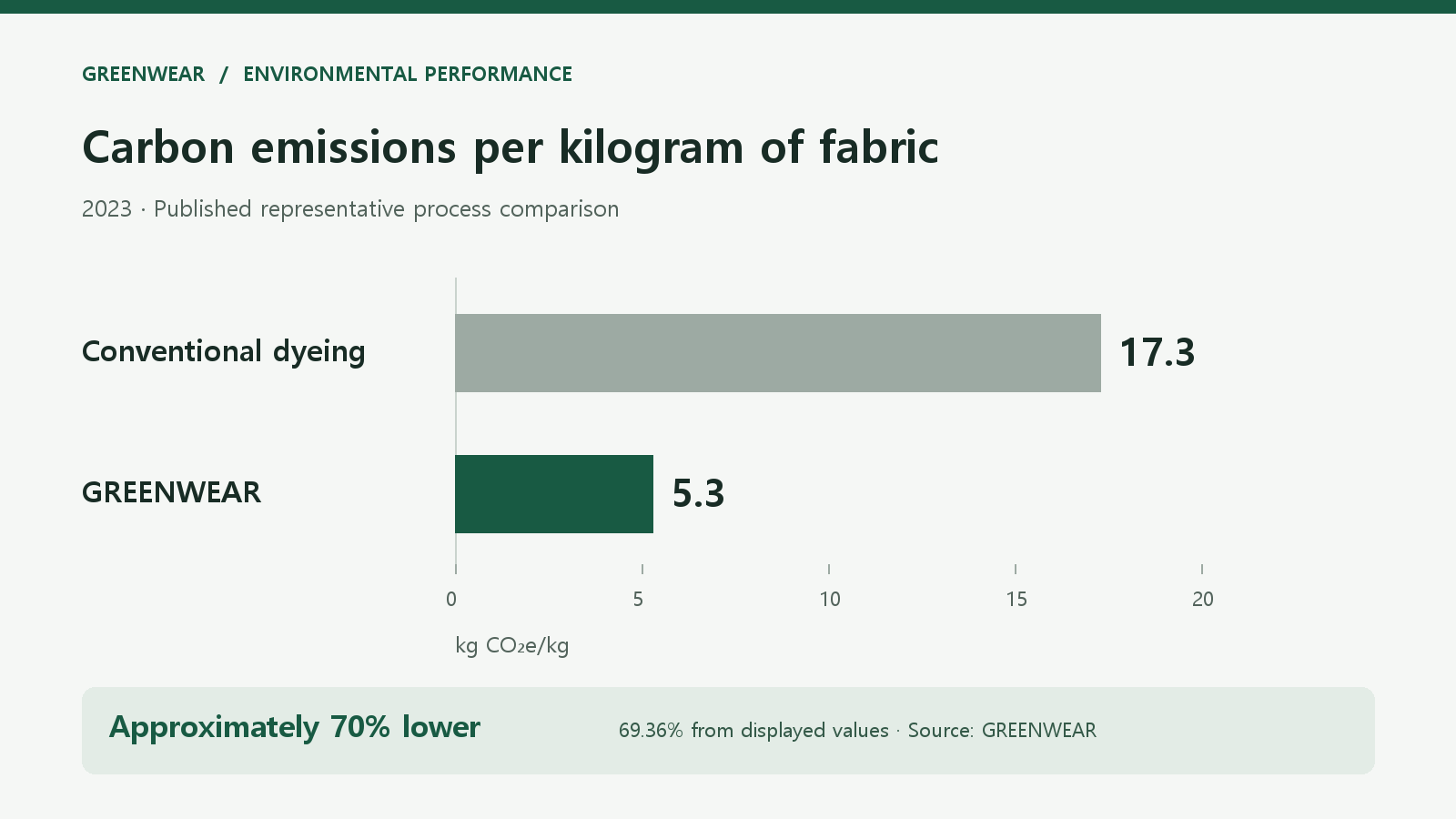
Carbon emissions in the published representative process comparison. The displayed values of 17.3 and 5.3 imply a 69.36% reduction. Source: GREENWEAR environmental performance.
Lower organic load and suspended solids in wastewater
Average measurements for 2022–2023 show BOD of 33.9 mg/L and TOC of 22.3 mg/L in GREENWEAR wastewater. The conventional chemical-dyeing wastewater used for comparison measured 468.5 mg/L for BOD and 318.8 mg/L for TOC.
Water quality indicator | Conventional dyeing | GREENWEAR | Reduction |
|---|---|---|---|
BOD · Biochemical oxygen demand | 468.5 | 33.9 | 92.8% |
TOC · Total organic carbon | 318.8 | 22.3 | 93.0% |
SS · Suspended solids | 125.0 | 25.1 | 79.9% |
T-N · Total nitrogen | 47.1 | 6.1 | 87.0% |
T-P · Total phosphorus | 2.4 | 0.7 | 70.8% |
Units: mg/L. Source: Yangju Fashion Color Industrial Complex tenant companies’ association, average comparison data for 2022–2023. Reduction percentages are calculated from the displayed values.
The substantial decreases in BOD and TOC indicate a lower organic load in the wastewater. Suspended solids, nitrogen and phosphorus also declined. These percentages describe changes in water-quality indicators measured per litre; they are distinct from a reduction in total wastewater volume.
A separate GREENWEAR wastewater test reported no detections across the 31 hazardous-substance parameters examined. Concentration comparisons and targeted substance testing together inform the management of wastewater characteristics.
Tracking inputs and residues in finished fabric
GREENWEAR links the management of production inputs with the substances remaining in the final product. Alongside process design that reduces synthetic auxiliaries, it tests finished fabric for residual hazardous substances.
A CENTEXBEL test summary reported organotin compounds below 0.10 mg/kg in the fabric tested. This measures residues in the finished fabric; it is a different indicator from the total amount of chemicals used in production.
When considering a change in dyeing, start by comparing results using the same units and assessment boundaries as the existing process. Explore GREENWEAR’s environmental performance data for its carbon and water-quality results.
What are GREENWEAR’s next climate goals?
GREENWEAR aims to expand the use of Biomass Natural Dyeing while improving energy efficiency and water use. The objective is to extend measured process improvements across more production settings.
Replacing 0.1% of conventional chemical dyeing worldwide
GREENWEAR’s adoption goal is to replace 0.1% of conventional chemical dyeing worldwide with Biomass Natural Dyeing. It aims to translate reductions demonstrated at fabric level into a larger volume of production using the technology. Quality and production capabilities across multiple materials and products support that expansion.
The dyeing industry already has equipment and skilled operating teams in place. GREENWEAR’s approach is to build on that infrastructure through the process adaptations needed for its technology. Expanding the processes that can be adopted within existing supply chains offers a route to industrial-scale change.
Improving energy efficiency by 30% and moving toward renewable energy
GREENWEAR is optimising its processes with a goal of improving energy efficiency by 30%. Alongside using energy more efficiently per unit of fabric produced, it is evaluating renewable energy as a way to reduce emissions from its energy supply.
This combines two priorities: lowering energy demand through shorter, lower-temperature processes, and reducing the carbon intensity of the energy used. The published representative process reduction is an existing result. Further efficiency gains and a renewable-energy transition are next-stage goals.
Recovering and reusing water in a closed-loop process
GREENWEAR aims to develop a closed-loop process that recovers and reuses water. Building on the lower pollutant concentrations already measured, it is researching recovery and reuse to reduce fresh-water inputs and treatment demand. The direction is to improve water use through both lower contamination and circulation within the process.
GREENWEAR’s ESG approach sets out its priorities for energy efficiency and water circulation. Measured results guide the next process improvements, while validated applications provide a foundation for wider adoption.
Brands considering a change in dyeing can start with four steps:
Define the material. Share the fibre composition, fabric construction and intended product use.
Align colour and quality requirements. Specify the target shade, required colourfastness, expected volumes and schedule.
Set an environmental comparison baseline. Compare carbon, energy, water and wastewater data using consistent units and boundaries.
Validate through a trial. Review sample quality and process compatibility, then define the scope of the production change.
GREENWEAR aims to bring the environmental benefits of Biomass Natural Dyeing to more products and production facilities. Discuss your material and process requirements to explore the conditions for adoption and the environmental improvements relevant to your products.
External sources
UNEP · Minimizing fashion’s environmental footprint, Annual Report 2025
UNEP · Textile-producing nations unite to reduce chemical waste (2022)
Cascale · Material Categories — Solution (dope) dyeing processes
Photo credit and licence
Jonathan Borba / Pexels · Close-up Texture of Blue Fabric Rolls · Pexels License